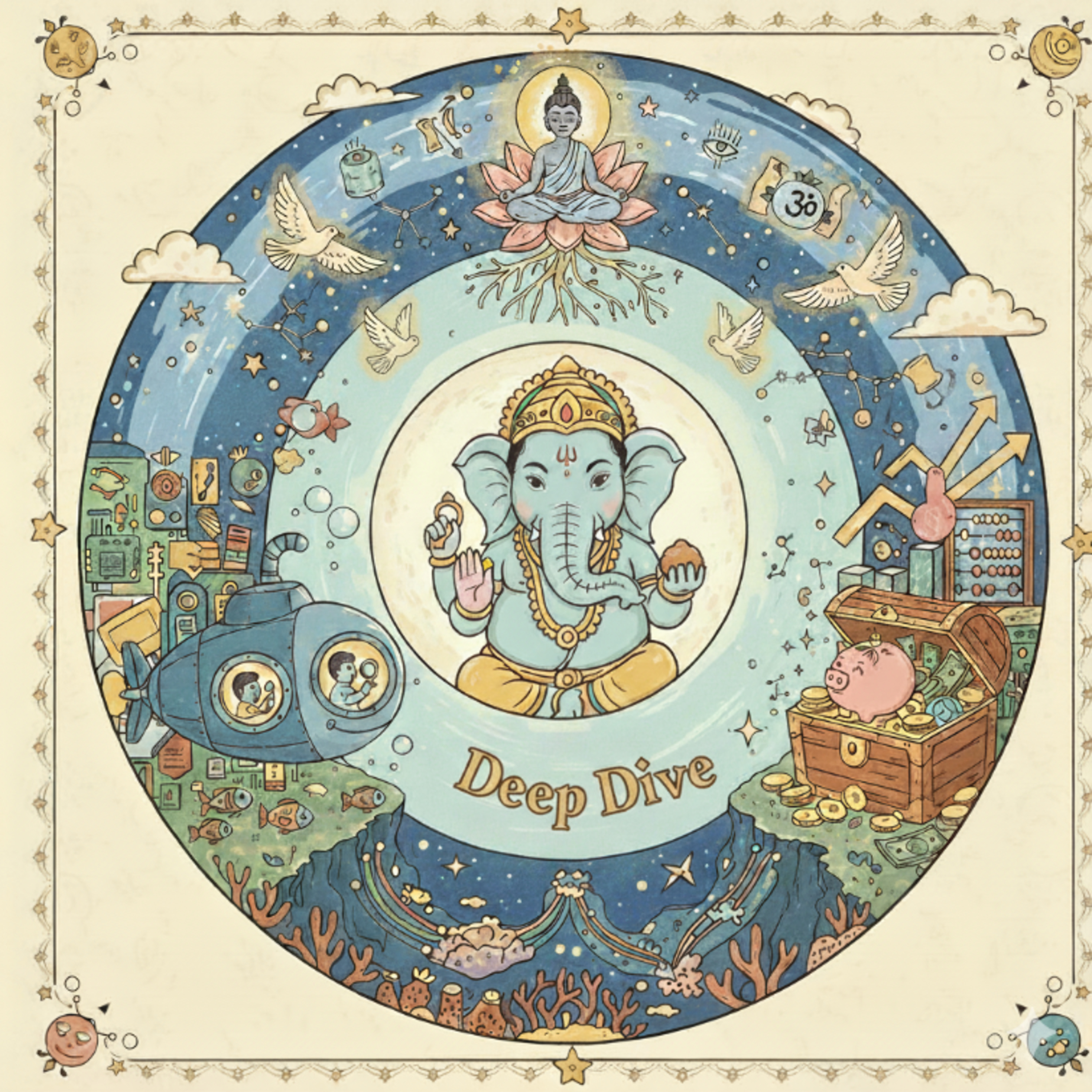

ResearchStep inside the profound schism separating artificial intelligence from human consciousness in this deep-dive episode. We rigorously analyze the structural divergence between efficient digital computation (the Turing machine model) and complex biological cognition (the messy reality of the brain). Why is it that traditional computing achieves its speed by relying on centralized, arbitrary symbolic values—like assigning "0000" to the concept "spoon"—while your brain requires an exponentially scaling architecture just to identify four possibilities?The Structural Demand for Meaning: Decentralization and GroundingWe tackle the Symbol Grounding Problem: Why does true meaning require decentralization at the basic binary "yes/no" unit level? The sources make clear that meaning cannot reside in a centralized look-up table because symbols in a computer are arbitrary—they lack intrinsic "spoon-ness". Cognition demands that symbols be grounded in sensory-motor experience.The real world arrives not as a clean symbol, but as a distributed flood of sensory data—millions of photoreceptors acting as decentralized "yes/no" units. Meaning is constructed bottom-up, assembled from the consensus of curvature detectors and grasp-affordance detectors. Centralizing this process would strip the input of its rich, high-dimensional geometry, losing the very essence of meaning. This decentralized structure also provides fault tolerance and graceful degradation, allowing concepts to remain robust even if many neurons misfire—a crucial biological necessity absent in brittle, centralized digital memory.From Grandmother Cells to Sparse Distributed Representations (SDR)We contrast the theoretical concepts of the "Grandmother Cell" (a single unit for a concept like "Jennifer Aniston")—which fails due to the Curse of Dimensionality and catastrophic capacity limits—with the brain’s elegant solution: Sparse Distributed Representations (SDR).SDR utilizes a vast, high-dimensional space where only a tiny fraction (e.g., 2%) of units are active at any time. This sparsity prevents Catastrophic Interference and allows the system to encode semantic overlap physically: if two concepts share 50% of their active bits, they are 50% similar. This requires projecting data into massive dimensions, validating the need for an exponentially larger number of cognitive units to maintain clear separability and 100% accuracy.Finally, we explore advanced models like Kanerva’s Sparse Distributed Memory (SDM), which rigorously prove that covering the high-dimensional "meaning space" requires an enormous physical substrate (hard locations). We conclude by examining Vector Symbolic Architectures (VSA), showing how complex concepts are formed by massive, simultaneous global operations (like binding and superposition) across thousands of bits, fundamentally differentiating cognitive operations from the localized logic of the Von Neumann architecture. The fundamental structural divergence is clear: computing prioritizes efficiency; cognition prioritizes semantic robustness and grounding, at a massive metabolic and topological cost.#CognitiveScience #AI #Neuroscience #Computation #Cognition #SymbolGrounding #SparseDistributedRepresentations #BrainArchitecture #Piaget #InformationTheory #HyperdimensionalComputing #NeuralNetworks #FormalThought #StructuralDivergence #MeaningMaking
See moreTop comments