
Real v/s Unreal through Samkhya : The Normal Distribution as "Vikara (defect) " and the Ontology of Mathematical Law
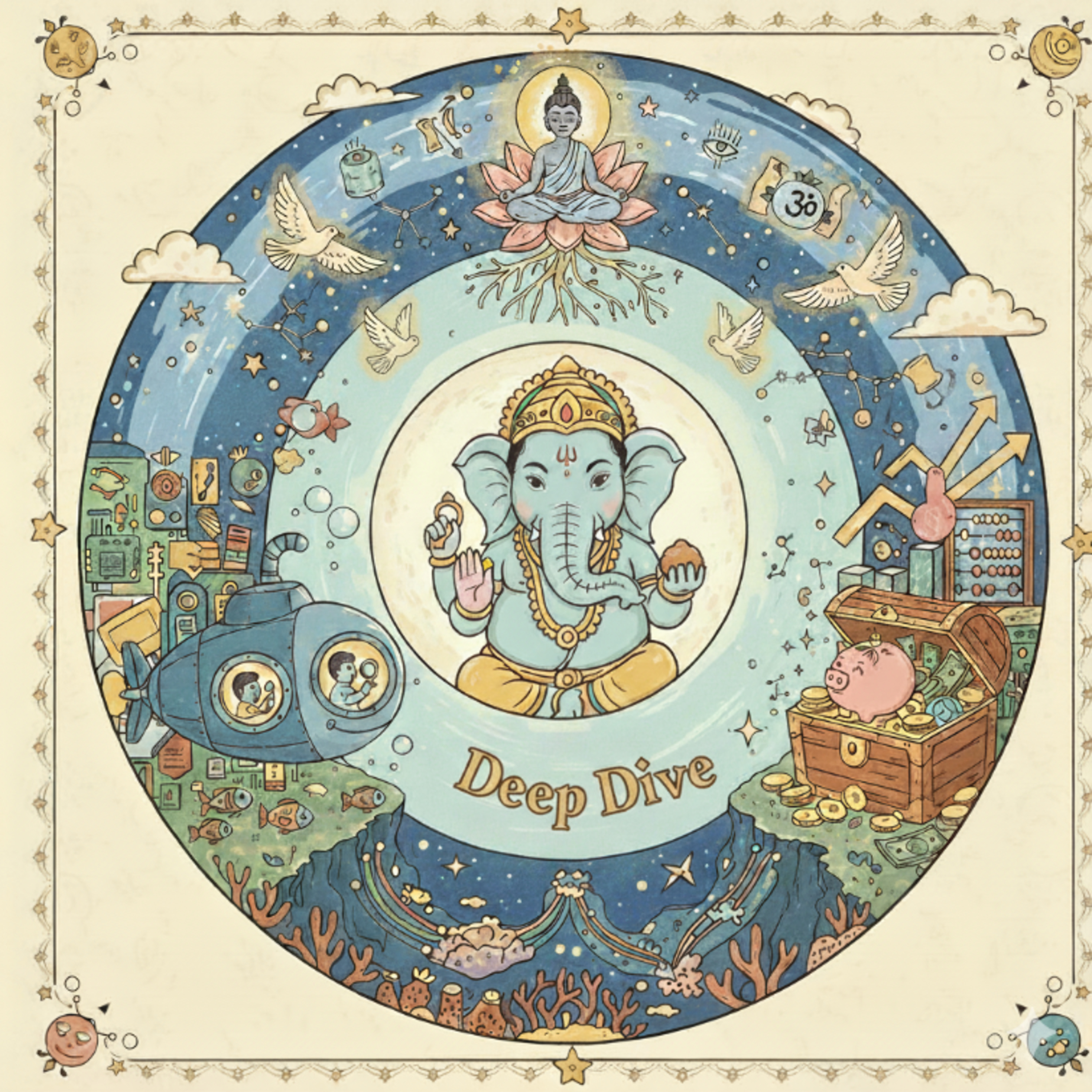 Deep Dive with Gemini
EpisodeNov 29, 202535m
ResearchThe ubiquitous Normal Distribution, or Bell Curve, governing phenomena from human heights to particle velocities, may not represent true reality but rather a fundamental defect. This radical ontological hypothesis redefines the physical world's adherence to the bell curve as Vikara, a Sanskrit term denoting imperfect modification, defect, or deviation from a primordial, perfect state.In this inverted ontology, the observable spread and scatter of the Bell Curve—the statistical Variance ($\sigma^2$)—is identified as "noise" or "distortion" introduced by the medium of manifestation (Prakriti or Maya). Conversely, the only true reality (Sat or Atman) is the underlying deterministic mathematical law—the dimensionless Mean ($\mu$), which is the pure Signal.This framework is supported by the dualistic philosophy of Samkhya, which explains cosmic manifestation (Vikara) through the interaction of the three Gunas: Sattva is the Mean (the signal, clarity), Rajas is the Variance (the active force that creates dispersion), and Tamas is the Noise Floor (inertia that obscures the signal). The physical world is considered the furthest, "most noisy" modification in this chain of defects. Advaita Vedanta reinforces this by describing the world as Maya (Illusion) resulting from the projection of multiplicity where only Unity exists.Crucially, this view challenges the idea of intrinsic randomness. Research into deterministic events, such as the coin toss, proves that the resulting probability distribution arises entirely from the observer’s physical clumsiness and epistemic limitation (Avidya), not the object's chance. The variance is therefore a map of the defect of the physical agent, not an ontological property of the object itself. The world is ruled by Rta (Cosmic Order); our perception is clouded by uncertainty.If the universe is a "noisy channel" transmission of perfect code, described by the "It from Bit" hypothesis, then Probability Theory is transformed from a descriptive science into a normative tool of epistemic filtration. Statistical methods, such as minimizing the sum of squared errors in regression, function as a "Yoga of Mathematics"—a systematic process of error correction or Viveka (discriminative discernment) designed to strip away the physical defects (Vikara/residuals) to recover the pristine, deterministic structure (the Law).In essence, the scientist, the statistician, and the yogi are engaged in the same fundamental task: the minimization of Variance. This process is the rejection of the physical variation to affirm the mathematical unity. The Normal Distribution is the beautiful, symmetrical veil of Maya; the goal is to look through the distribution to the single, dimensionless point of truth that lies hidden at its center.#Vikara #NormalDistribution #InvertedOntology #BellCurve #Atman #ProbabilityTheory #Samkhya #Vedanta #InformationRealism #SignalDetection #EpistemicFiltering #MathematicalPhysics #Rta #DeterministicUniverse #CosmicOrder
See moreTop comments